It's tempting to talk about "how markets did" this week as if there's one answer. There isn't. While U.S. indices pushed to fresh records, Asia-Pacific markets spent the same stretch trading cautiously, weighed down by rising oil prices tied to renewed uncertainty over the Strait of Hormuz — a useful, concrete reminder that regional markets often respond to the same global headline in very different ways.
Asia-Pacific: a mixed and cautious session
Japan's Nikkei 225 closed lower by roughly 0.12% at 65,606.71, while South Korea's Kospi fell about 0.60% to 6,258.77 in choppy trading. Australia's S&P/ASX 200 finished essentially flat. Not every Asian market moved the same direction, though: Hong Kong's Hang Seng index rose around 0.44%, and mainland China's CSI 300 closed roughly 0.93% higher, helped by July export growth that beat analysts' expectations. The mixed picture across the region reflects two forces pulling in opposite directions at once — rising oil prices weighing on energy-import-dependent economies, against pockets of stronger local economic data.
Europe: steadier footing
European markets opened the same trading session in positive territory, with the pan-European Stoxx 600 benchmark up around 0.24% in early trade and finishing the week up roughly 1.70% in local-currency terms, according to weekly fund manager updates. European equities were described as supported by firmer risk appetite and resilient corporate earnings, even as the geopolitical backdrop tied to Hormuz remained volatile in the background.
The US: a different story entirely
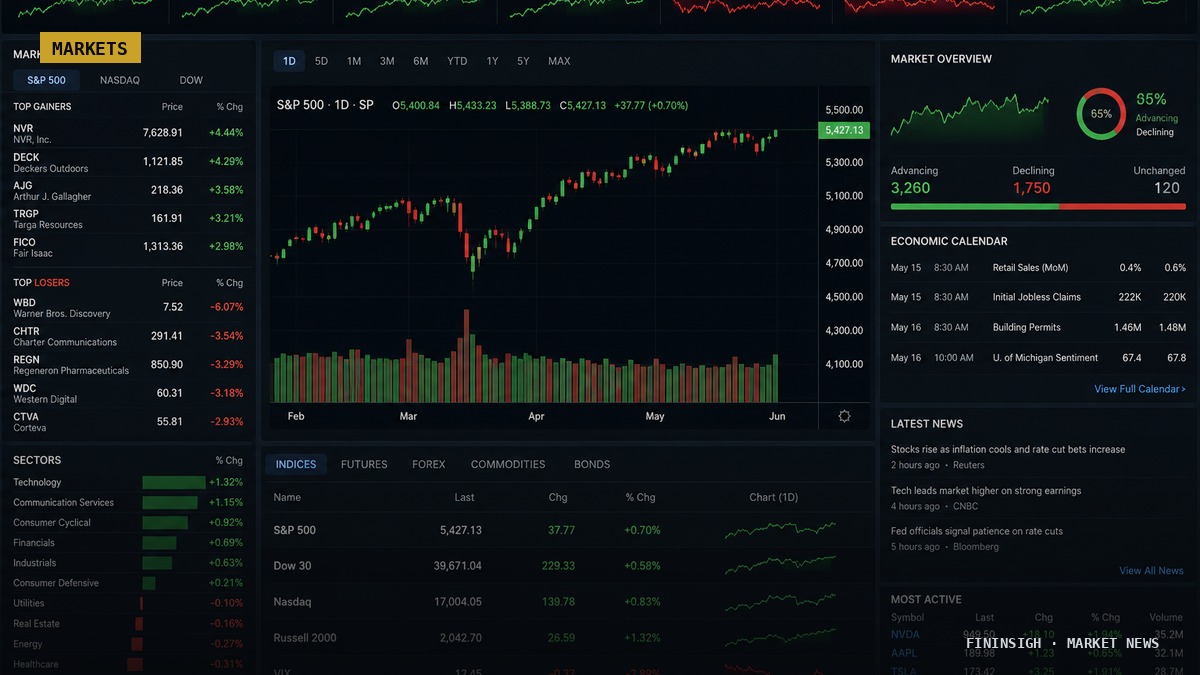
U.S. markets, by contrast, closed out the same week at fresh record highs, with the S&P 500 finishing at 7,757.64 and the Nasdaq Composite up over 1% on its best day. The dominant U.S. narrative was domestic — a softer-than-expected July jobs report that reduced near-term Fed rate-hike expectations — rather than the oil-and-shipping story that weighed more heavily on Asian trading desks. For the full domestic picture, see our earlier coverage of Wall Street's record-high close.
Why the same headline hits regions differently
The same underlying story — Hormuz tensions pushing oil prices higher — produced meaningfully different regional reactions, and that's not a coincidence. Several Asian economies, including Japan and South Korea, are significant net oil importers, so a sustained rise in energy costs has a more direct effect on their import bills, corporate input costs, and inflation outlook. The U.S., by comparison, has a much larger domestic energy production base, which cushions some of that direct impact, and its market was additionally distracted by a strong domestic catalyst (the jobs report) that had little to do with oil at all. Europe, meanwhile, was weighing its own mix of earnings strength and geopolitical caution, landing somewhere in between. For more on how oil prices are moving and why, see our companion piece on rising oil prices and the Strait of Hormuz.
The takeaway for a diversified portfolio
This kind of regional divergence is a real-world illustration of why geographic diversification is more than a textbook concept. A portfolio concentrated entirely in one region's equities is exposed to that region's specific sensitivities — energy dependence, currency moves, local monetary policy — on top of general market risk. Weeks like this one, where the same global headline produces different outcomes across Asia, Europe, and the U.S., are a useful reminder of why spreading exposure across regions can smooth out some of that variation over time. Our guide on how diversification can reduce portfolio risk covers this in more depth.