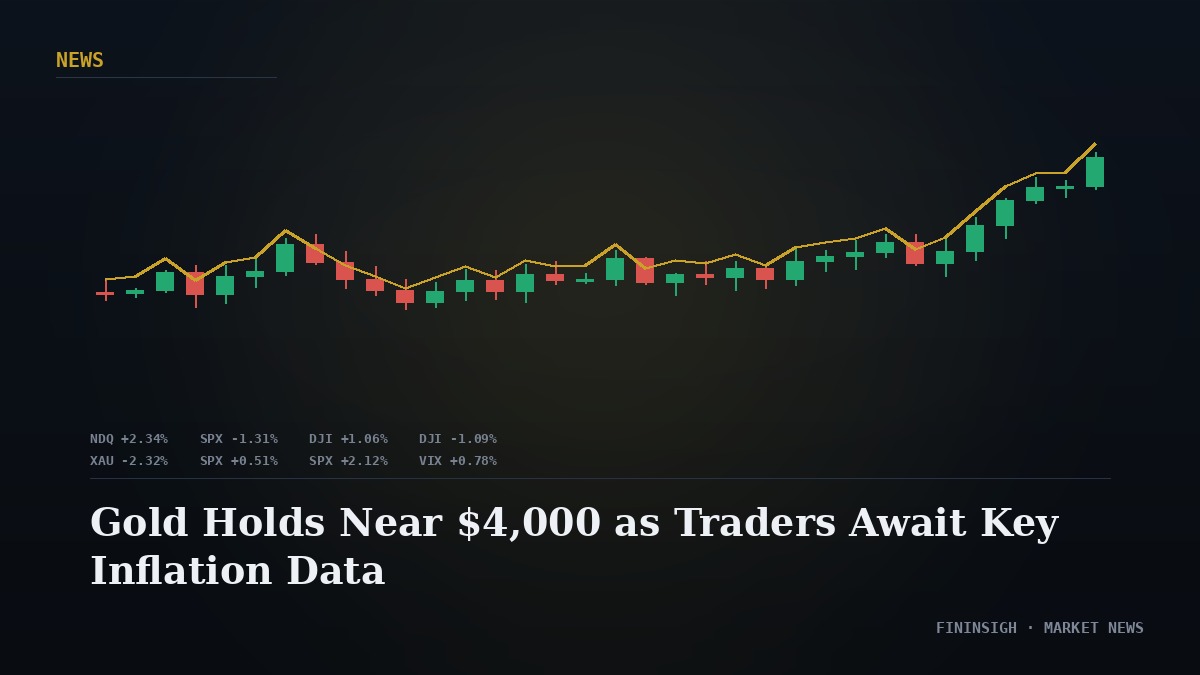
Gold has spent much of early August trading in a range around $4,000–4,030 an ounce, a level that leaves the metal down roughly 28% from the record high near $5,598 it touched back in January. After a volatile first half of the year, gold's price action has settled into a narrower band as traders wait for a run of US economic data releases — including July inflation figures — that could determine the metal's next significant move.
Where Gold Stands
Spot gold has been little changed in recent sessions, holding just above the $4,000 mark as investors position ahead of upcoming data. Silver, platinum, and palladium have seen periods of relative outperformance during parts of this year's rally, with investors broadening precious-metals exposure beyond gold alone during periods of heightened economic uncertainty.
Why the Pullback From January's Peak
Gold's retreat from its January record reflects a shift in how markets are pricing Federal Reserve policy. Earlier in the year, expectations for a steady stream of interest rate cuts helped drive gold to successive records — lower rates reduce the opportunity cost of holding a non-yielding asset like gold, which pays no interest or dividend. As those rate-cut expectations have been pared back over the course of the year, with the Fed holding its benchmark rate steady in a 3.50%–3.75% range, gold has given back a substantial portion of its earlier gains.
Second-quarter global gold demand also declined to its lowest level since 2021 according to industry data, adding a fundamental demand-side factor to the shifting rate outlook.
The Fed Variable
The Federal Reserve, now under the leadership of Chair Kevin Warsh, has held its policy rate steady at recent meetings while reaffirming a commitment to bringing down inflation. Notably, some Federal Open Market Committee members have indicated that further policy tightening could still be necessary — a more hawkish signal than markets were pricing earlier in the year, and one that has weighed on gold given the metal's inverse relationship with real interest rates.
Market pricing for the Fed's next moves has shifted around in recent weeks. Futures markets have alternated between pricing a hold and a small probability of a further rate increase at upcoming meetings, underscoring how unsettled the rate outlook remains heading into the fall.
What Forecasters Are Watching
Wall Street's gold price forecasts for the rest of 2026 vary meaningfully. Several major banks have trimmed their year-end targets in recent months to a range roughly between $4,000 and $4,900 an ounce, citing reduced conviction that the Fed will cut rates significantly this year. Even the more conservative forecasts still sit at or above current levels, reflecting continued underlying support from central bank buying and demand for portfolio diversification, even as the most bullish scenarios from earlier in the year look less likely to play out.
In the near term, a cluster of US data releases through the rest of August — including the Consumer Price Index, Producer Price Index, and various regional manufacturing surveys — will give the market fresh evidence on where inflation and growth are heading, and by extension, where Fed policy is likely to go next.
The Bigger Picture
Gold's round trip this year — from record highs in January to a substantially lower range by August — is a useful reminder that even traditional "safe haven" assets can be highly volatile over shorter time horizons. For investors who hold gold as part of a diversified portfolio for its historical role as an inflation hedge or portfolio diversifier, near-term price swings driven by shifting rate expectations are part of the normal picture, not necessarily a signal to change a long-term allocation.