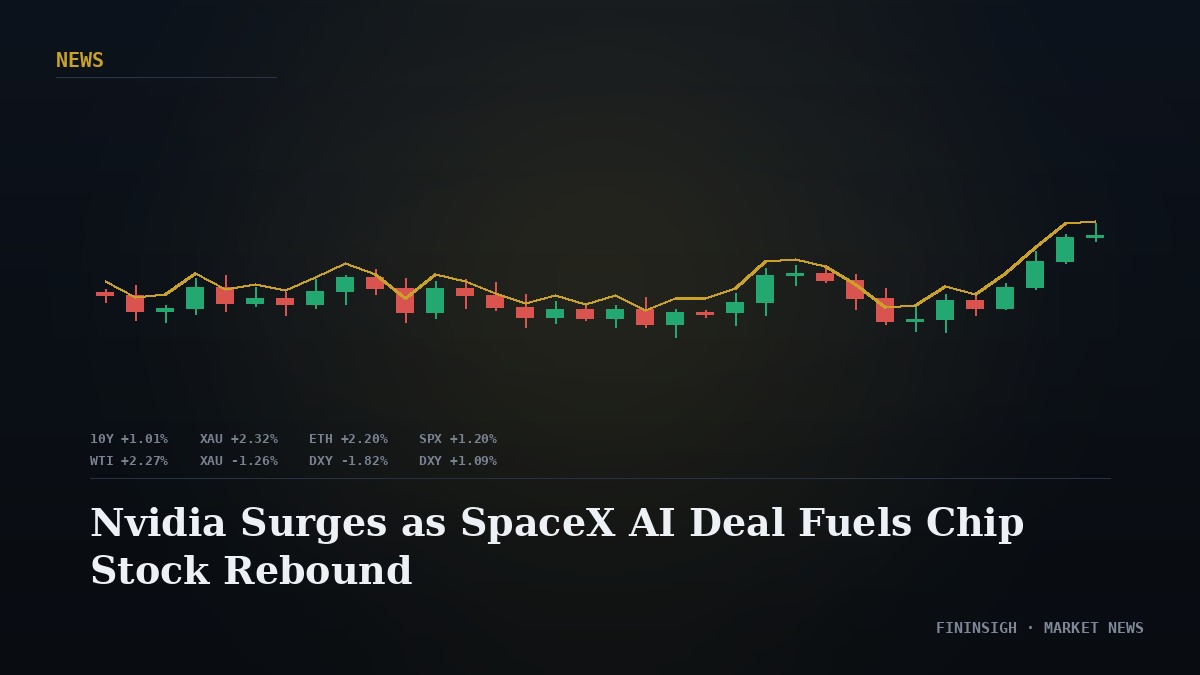
Shares of Nvidia climbed more than 10% over the course of last week, with the stock up over 1% in a single session after comments from an unexpected source: SpaceX. During the rocket company's first earnings call since going public in June, CEO Elon Musk said SpaceX had decided to build its AI infrastructure "exclusively" on Nvidia hardware, citing the company's Vera Rubin architecture — which combines CPUs designed for data movement and workload orchestration with GPUs built for query-response processing — as the best available option for its needs.
The Comments That Moved the Stock
Musk's comments came on August 4, during SpaceX's first quarterly earnings call as a newly public company. For a chip sector that had been under significant pressure through July, a specific, named commitment from a high-profile technology company carried real weight — markets have grown accustomed to broad AI-spending narratives, and a concrete "we've decided to build exclusively on Nvidia" statement is a more specific catalyst than general sector optimism.
SpaceX's Own Volatile Stretch
The AI-partnership comments arrived during a turbulent period for SpaceX's own stock. Since its market debut in June, the company's shares have lost more than $500 billion in market capitalization at one point, and were trading over 17% below their opening price as of early August. Despite that decline, retail investors have reportedly bought SpaceX shares on net every single trading day since the IPO, according to tracking firm VandaTrack. The stock then staged a sharp reversal of its own: shares gained 12% in a single session after key insider lock-up provisions expired and new shares became available to investors, putting the stock on track for a nearly 19% weekly advance even as it remained down significantly from its debut levels. Wall Street's own view has stayed broadly bullish throughout — Deutsche Bank, for instance, maintained a buy rating and a price target implying substantial upside from recent levels, with analysts pointing to Starship's progress and the potential for large government or sovereign AI deals as key factors in their long-term thesis.
The Broader Chip-Sector Rebound
Nvidia's move was part of a wider recovery across semiconductor names, which had one of their strongest four-day stretches since 2020 earlier in the period, following a rough July that some strategists described as an "AI unwind" — a cooling-off in speculative positioning built up earlier in the year. That rebound has been cited by several market strategists as a reason for cautious optimism heading into the rest of August: if enough of the excess speculation was cleared out in July, the argument goes, the sector may have a more sustainable base to climb from — though this remains an interpretation, not a guarantee.
Reading Single-Company Catalysts Carefully
It's worth being precise about what actually happened here: one company's stated hardware preference moved another company's stock price significantly, inside a sector that was already primed to react strongly to AI-related news given the run-up in valuations and positioning earlier in the year. That's a useful, concrete example of how concentrated a rally can be even when headline index numbers look broadly positive — a handful of specific corporate announcements, not a broad-based shift in every company's fundamentals, can account for a large share of a single stock's or sector's move in a given week.
What This Means for Diversified Investors
For investors holding broad, diversified positions rather than concentrated bets on individual AI infrastructure names, weeks like this are worth understanding rather than chasing. A single earnings call comment moving a major stock double digits is a reminder of how much idiosyncratic, company-specific risk exists even within a sector everyone agrees is important — which is part of why concentrating a portfolio too heavily in any single theme, however compelling the story, carries real risk alongside the potential reward. Our guide on how diversification can reduce portfolio risk covers this trade-off in more depth.