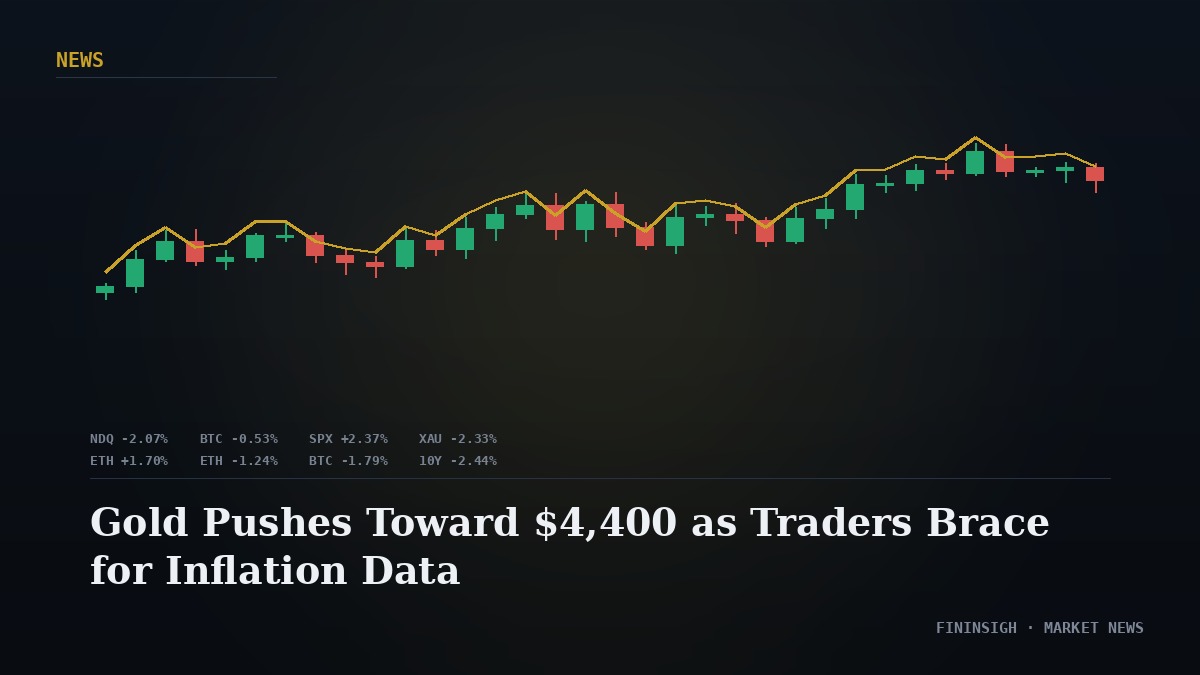
Gold's path over the past few weeks has been a useful reminder of how quickly sentiment in this market can shift. After finding support near $4,000 in late July — and briefly dipping below that level — the metal has pushed meaningfully higher, with recent trading levels closer to the $4,300–$4,400 zone and some technical analysts flagging resistance around $4,441.
From $4,000 to the $4,400 Zone
In late July, spot gold closed near $4,053 an ounce after briefly dipping below the psychologically important $4,000 mark. At the time, support was seen in the $3,950–$4,000 range, with resistance flagged around $4,100–$4,180. Since then, the metal has extended its advance well beyond that earlier resistance zone, with several trackers describing the move as gold's continuation of an uptrend that began after a broader correction earlier in the year. The scale of the move over a matter of weeks underscores how sensitive gold remains to shifting expectations around inflation and monetary policy.
What Changed
A few threads have supported the move. Continued uncertainty tied to the Strait of Hormuz situation has kept a geopolitical bid under the metal, even as headlines have oscillated between optimism and setbacks on a shipping-lane agreement. At the same time, signals from Federal Reserve officials floating the possibility of a rate hike — rather than the cuts markets had priced in earlier in the cycle — have added a layer of uncertainty that has, somewhat counterintuitively, supported gold as investors hedge against a range of possible outcomes rather than a single clear path.
The CPI Catalyst
This week's July Consumer Price Index release, due Wednesday, is widely viewed as the next major catalyst for gold's direction. Higher-than-expected inflation would likely reinforce the case for a Fed rate hike, which could cut both ways for gold: higher rates typically increase the opportunity cost of holding a non-yielding asset like gold, but persistent inflation concerns and the market volatility that can follow a hawkish surprise often reinforce gold's traditional role as a hedge. A cooler-than-expected CPI print, conversely, would likely ease hike expectations and could remove some of the uncertainty-driven support that has helped gold's recent advance. Markets are expected to see above-average volatility around this release specifically because the outcome isn't obvious in either direction.
Why Forecasts Vary So Widely
Readers researching gold's outlook will notice analyst price targets for the rest of 2026 vary enormously — from projections in the $3,300 range on the pessimistic end to $6,000 or higher from some major bank research desks on the optimistic end. This isn't a sign that forecasting is unreliable so much as a reflection of how much gold's path depends on a handful of genuinely uncertain variables: the resolution (or not) of the current geopolitical situation, the actual path of Fed policy over the coming months, and the pace of central bank gold buying globally. Rather than anchoring to any single price target, it's more useful to understand which of these variables is driving a given forecast.
The Bigger Picture for Gold in a Portfolio
Whatever this week's CPI print shows, the broader lesson from gold's recent swings is a familiar one: even a traditional "safe haven" asset can be genuinely volatile over short periods, and its price reflects the market's evolving read on inflation, rates, and geopolitical risk all at once — not a single, simple driver. For readers newer to how gold and other assets fit into a broader strategy, our guide on how diversification can reduce portfolio risk covers how different asset classes can behave differently under the same conditions.