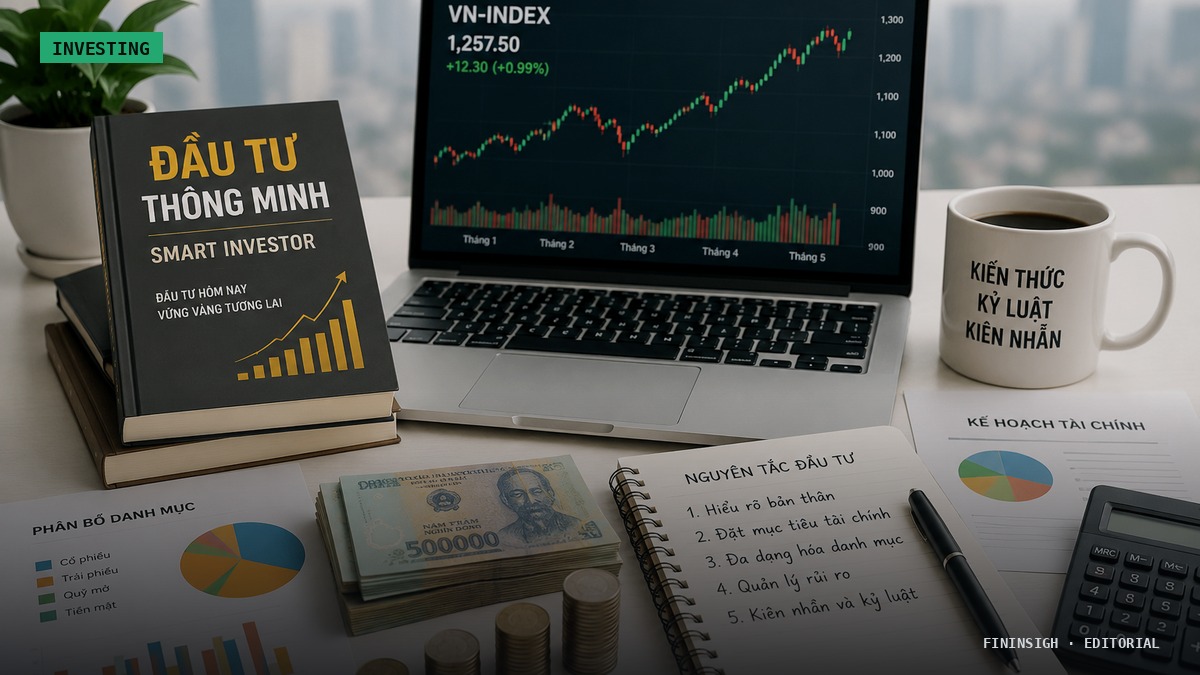
Ask ten experienced investors what matters most, and you'll get ten slightly different answers wrapped around the same core ideas. Strip away the specifics of any individual strategy, and five principles tend to resurface again and again — not as secrets, but as the unglamorous fundamentals that separate a repeatable process from a series of one-off bets.
1. Know yourself first
Before choosing a single asset, it's worth being honest about two things: your actual financial capacity for risk, and your emotional tolerance for watching your portfolio move. These aren't the same thing. Someone might have the financial capacity to withstand a 30% drawdown but the temperament to panic-sell at 10%. A strategy that looks optimal on paper is worthless if you can't actually stick with it when markets get uncomfortable. Self-awareness — about your time horizon, your income stability, your reaction to volatility — is the foundation everything else gets built on.
2. Set a specific financial goal
"Grow my money" isn't a goal you can build a plan around. A specific goal — a target amount, tied to a purpose and a rough timeframe — gives you something concrete to measure progress against and helps determine which strategies are even appropriate. Money needed in three years generally calls for a different approach than money earmarked for a goal two decades away. Vague intentions tend to produce vague, inconsistent behavior; specific goals make it easier to evaluate whether you're actually on track, and to know when it's reasonable to adjust course.
3. Diversify your portfolio
Spreading exposure across different assets, sectors, and geographies remains one of the few tools that can reduce risk without necessarily sacrificing expected return. It works because different holdings don't all move together — when one part of a diversified portfolio struggles, another may hold steady or even benefit from the same conditions. Diversification isn't a guarantee against loss, and it won't protect against a broad market decline that hits nearly everything at once, but it meaningfully reduces the damage any single bad decision or unlucky holding can do to your overall results. For a deeper look at how this works in practice, see our guide on how diversification can reduce portfolio risk.
4. Manage risk deliberately
Risk management isn't a separate activity you do occasionally — it's a standing discipline that shapes every decision, from how much you allocate to a single position to when you'd reconsider a holding. That includes position sizing (not putting too much into any one bet), understanding what could go wrong with a given investment before you make it, and having at least a rough sense of your exit conditions in advance, rather than deciding under pressure. The investors who manage risk deliberately tend to survive the inevitable bad stretches; the ones who don't are the ones a single bad year can meaningfully set back. Our guide on risk management fundamentals covers this in more depth.
5. Stay patient and disciplined
This is often the hardest principle to actually live by, because it asks you to do less, not more, exactly when doing something feels most urgent. Markets are volatile in the short term and have historically trended upward over long periods — but that long-term pattern only benefits investors who stay invested through the noisy stretches in between. Patience means not abandoning a sound plan because of a rough quarter; discipline means not abandoning it because of a great one, either. Both are about sticking to a process you've already thought through, rather than reacting to whatever the market did this week.
Putting the five together
None of these five principles is complicated in isolation, and none of them is unique to any one strategy, broker, or market. What actually separates durable, repeatable investing behavior from a string of disconnected decisions is whether all five are applied together, consistently, over time. Self-awareness shapes your goals; your goals shape how you diversify; diversification and risk management work together to define how much any single mistake can cost you; and patience is what lets the whole system actually compound. Treat them less as a one-time checklist and more as a set of habits to revisit whenever you're about to make a meaningful financial decision.